
Commercial Refrigeration Repair
Commercial Refrigerator Repair vs Replacement: Cost-of-Downtime Analysis
Should you repair or replace your commercial chiller? Age rules, energy-efficiency math, true cost of downtime for F&B operators.
The Commercial Decision Framework
You know how quickly a minor temperature fluctuation can spiral into a massive headache for a food and beverage operation. The commercial refrigeration repair vs replacement question might look similar to a residential issue on paper, but the stakes are completely different. A broken home fridge inconveniences a family.
A commercial refrigeration failure threatens your daily revenue, ruins expensive stock, and puts your HACCP compliance at severe risk.
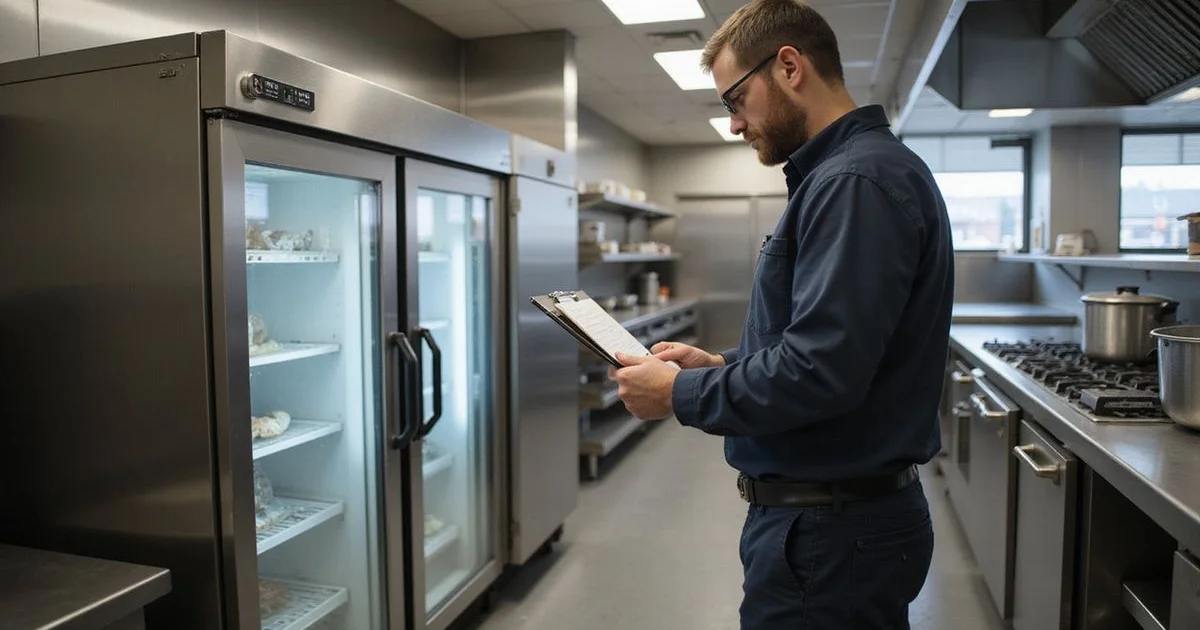
Our commercial team walks customers through a specific decision framework during diagnostic visits to take the emotion out of the choice. This structured approach helps owners make fast, cost-effective calls when a chiller goes down.
Let us look at the specific data points that drive this decision. We will outline the exact numbers you need to evaluate, the true cost of operational downtime, and a practical way to plan your next equipment upgrade.
The Three Numbers
For any commercial refrigeration unit, three specific numbers drive the financial decision. These figures separate an emotional choice from a profitable business strategy.
1. Age of the Unit
If you are wondering when to replace commercial fridge systems, the age of your equipment dictates its baseline reliability and expected remaining lifespan. Units under seven years old usually warrant a repair, while systems over twelve years old are prime candidates for replacement.
| Age | Default Stance |
|---|---|
| Under 7 years | Repair almost always wins |
| 7-12 years | Case-by-case based on fault and condition |
| 12+ years | Replacement leans favourable |
Commercial refrigeration runs much harder than residential systems. These units face high-cycle usage, continuous 24/7 operation, and heavy environmental loading from kitchen humidity and harsh cleaning chemicals. Useful life tops out around 12 to 15 years for most commercial units, though some premium models stretch to 18 years with rigorous maintenance schedules.
Malaysia’s year-round hot and humid weather forces compressors to work overtime compared to equipment in temperate climates. We strongly recommend checking the manufacturing date plate on your condenser immediately. Pushing an overworked compressor past its tenth year in a Petaling Jaya restaurant often leads to sudden failure during your busiest lunch rush.
2. Repair Cost as % of Replacement
The commercial 40% rule states that if a single repair exceeds 40% of the walk in cooler replacement cost, you must replace the unit. This threshold protects your business from sinking capital into a failing system.
This rule is more conservative than the residential 50% standard for several critical reasons:
- Commercial replacement costs are higher in absolute terms.
- Multiple failures cascade more frequently on commercial equipment, where one fault signals others are incoming.
- Downtime risk during the repair itself is significant for active food and beverage operations.
Consider this worked example for a mid-size walk-in chiller measuring 8x8x8 feet:
- New unit installed cost: RM45,000
- 40% threshold: RM18,000
- Compressor, condenser, and electrical refurbishment quote: RM22,000
Since the RM22,000 quote sits above the threshold, you should proceed with a replacement. The remaining components on a 10-year-old unit will likely need extensive work within 24 to 36 months anyway. Our technicians frequently see operators replace a condenser fan motor only to have the evaporator coil fail three months later. You avoid this costly trap by strictly following the 40% rule.
3. Energy Efficiency
Modern commercial refrigeration uses 30% to 50% less electricity than models built a decade ago. Upgrading to a newer inverter model directly lowers your monthly operational overhead.
For a typical Petaling Jaya restaurant running multiple cooling units around the clock, this efficiency gap translates to an RM800 to RM2,500 lower monthly TNB bill following a full equipment refresh. Older units consume significantly more power due to several common degradation factors:
- Worn door gaskets allowing cold air to escape continuously.
- Inefficient, outdated compressor technology drawing excess amperage.
- Scale and grease buildup on aging condenser coils.
- Hardened lubricants increasing mechanical friction.
We calculate that over a 24-month payback window, the energy savings alone often justify the new-unit cost. Recent adjustments to the TNB commercial tariff rates, alongside 2026 Imbalance Cost Pass-Through surcharges, make inefficient appliances a massive financial liability.
The True Cost of Downtime
Downtime costs significantly exceed the raw price of replacement parts and labor. A single outage event can easily drain RM5,780 to RM22,050 from a mid-size restaurant.
This is the exact factor most operators severely underestimate. When a walk-in chiller fails, the financial impact ripples through the entire business:
| Cost Category | Typical Range (Mid-Size Restaurant) |
|---|---|
| Lost stock (compromised inventory) | RM2,000-RM8,000 |
| Lost revenue (next-day operations affected) | RM3,000-RM12,000 |
| Emergency callout premium | RM280-RM550 |
| Customer disappointment and reputation damage | Hard to quantify, but very real |
| Staff scrambling and management time | RM500-RM1,500 |
| Total per outage event | RM5,780-RM22,050 |
A unit that produces one of these events per year costs the business RM5,000 to RM22,000 annually beyond the visible repair invoice. That specific number changes the repair versus replace math entirely.
The Ministry of Health Malaysia enforces strict Food Hygiene Regulations 2009, mandating that chilled food must remain below 5°C. A faulty fridge that pushes your stock into the danger zone triggers mandatory disposal costs and exposes your business to severe compliance fines.
If your aging equipment is having one outage per year and the next repair is quoted at “only” RM3,000, the true calculation is much worse. The reality is RM3,000 to fix it today, plus a probable RM5,000 to RM22,000 outage event within 12 months. We always remind clients that a new unit at RM45,000 with zero outages amortises highly favourably over a 3 to 5 year horizon.
Scheduled Replacement Beats Reactive Failure
Planning your equipment upgrade before a total failure saves your business 25% to 40% on total replacement costs. Scheduled replacements allow for competitive bidding and controlled installation timelines.
Reactive replacement occurs when your current unit just failed and you need a new one immediately:
- You have no time to shop multiple suppliers.
- You lose all leverage to negotiate pricing.
- You are forced to take whatever inventory is available now.
- Installations are rushed to minimise expensive downtime.
- You pay premium pricing across the board.
Planned replacement occurs when your current unit reaches the end of its economic life, and you replace it on schedule:
- You gain 4 to 6 weeks to source equipment from multiple suppliers.
- You have leverage to negotiate brand selection and pricing.
- You can schedule the installation during a low-business window.
- You get the time to evaluate high-efficiency tier options.
- You secure standard market pricing or better.
In Malaysia, sourcing specialized high-efficiency compressors or specific PIR cold room panels often requires a significant lead time from suppliers. Operators who let equipment run until reactive failure pay standard premiums plus the full downtime cost. Proactive owners who plan replacements at the 10 to 12 year mark pay normal market rates while maintaining complete control over their operations.
Refurbishment as a Third Option
Refurbishment provides a middle-ground solution by replacing major mechanical components while preserving the physical walk-in structure. This path makes financial sense when your insulated panels remain in excellent condition.
Sometimes the best answer is neither a full replacement nor a risky patch job. Refurbishment involves replacing the condensing unit and major mechanical parts while keeping the existing walk-in panels intact.
Consider a refurbishment project when these specific conditions are met:
- The walk-in panels and structure are completely sound, usually under 15 years old with zero insulation degradation.
- The condensing unit and major mechanical components are failing repeatedly.
- The total refurbishment cost lands between 40% and 60% of a full replacement.
- The operator wants to defer a full, structural replacement for another 5 to 7 years.
Refurbishment also allows you to upgrade to modern refrigerants, helping you future-proof your system as the Malaysian Department of Environment phases out older gases like R22. We provide detailed refurbishment assessments alongside our standard repair and replacement quotes. This targeted approach offers the perfect middle path for many local food and beverage operators.
Quick Decision Matrix
Our quick decision matrix provides a clear, scenario-based guide for your commercial refrigeration equipment. Use this reference table to make immediate, data-driven calls during a system breakdown.
| Scenario | Recommendation |
|---|---|
| Unit under 7y, single component fault | Repair |
| Unit 7-12y, repair < 40% of new | Repair (with monitoring) |
| Unit 7-12y, repair > 40% of new | Refurbish or replace |
| Unit 12+y, any major fault | Replace |
| Unit 7+y with multiple faults in 12 months | Replace (cascading decline) |
| Unit on R22 needing significant work | Replace (refrigerant premium tips the math) |
| Sealed-system fault on unit 7+y | Lean replace |
| Door or gasket or minor fault any age | Repair |
| Controller or PCB fault under 10y | Repair |
Energy Efficiency Math Worked Example
Calculating the exact power consumption differences reveals how quickly a new unit pays for itself. A modern inverter chiller generates tens of thousands of Ringgit in savings over its operational lifespan.
Consider the data for a 2014 walk-in chiller running at typical efficiency for its era:
- Power consumption: ~3.2 kW continuous, 28,032 kWh/year
- Cost at RM0.36/kWh: RM10,092 per year
Compare that to a 2026 inverter walk-in chiller of equivalent capacity:
- Power consumption: ~2.0 kW continuous, 17,520 kWh/year
- Cost at RM0.36/kWh: RM6,307 per year
- Annual savings: RM3,785
Over a 12-year service life of the new unit, you generate RM45,420 in cumulative TNB savings. That specific number alone often fully amortises the initial replacement cost.
These calculations use a highly conservative base rate of RM0.36/kWh. If your commercial premises falls under a higher TNB Tariff B bracket or incurs maximum demand charges, your actual monthly savings will be significantly larger. For a complete view of how regular maintenance extends the useful life of your existing equipment, see our restaurant refrigeration maintenance contracts guide.
How We Help Customers Decide
Our technicians provide three specific data points before starting any emergency repair work. This transparency ensures you never waste capital patching a doomed system.
During emergency callouts on aging equipment, we supply these numbers immediately:
- The repair quote (itemised for parts, labor, refrigerant, and warranty)
- The 40% threshold (based on equivalent new unit pricing)
- The estimated remaining life (if the proposed repair is completed)
If the math clearly dictates a replacement, we say so directly.
We install and commission new equipment across Petaling Jaya, so there is zero conflict of interest in giving you an honest call. You can schedule a fast, professional evaluation to protect your inventory today.
WhatsApp +60 14-850 9211 for an honest assessment on your unit.
Commercial Refrigerator Repair vs Replacement: Cost-of-Downtime Analysis — FAQs
When is a commercial chiller past economic repair?
How much do new walk-in chillers cost in Malaysia?
Can you help with replacement procurement?
Related Guides
Cake Display Fridge Troubleshooting (Bakery and Cafe Owners)
Common faults in cake display chillers: glass condensation, uneven cooling, frost buildup, short-cycling. Quick checks before calling Chill Pro PJ.
Why Is My Commercial Freezer Tripping the Power?
Freezer keeps tripping the breaker? Common electrical faults: compressor short, starter relay, fan motor, defrost element, moisture intrusion.
Preventive Maintenance Contracts for Restaurant Refrigeration
What a real B2B refrigeration maintenance contract covers: monthly vs quarterly, HACCP documentation, cost-of-prevention math for F&B owners.
Walk-In Chiller Not Cooling: Diagnosis Guide for F&B Operators
Restaurant chiller not cooling? Triage steps to save your stock plus the four most common causes — refrigerant leak, compressor, condenser, defrost.
Ready to talk to a technician?
Need help with commercial refrigeration repair?
We are based in Taipan Damansara 2 — same-hour callout in Ara Damansara, same-day across PJ. Honest pricing, no upselling.